Preparing for the revised NQS: Discussions with assessors

With the revised National Quality Standard coming into effect on February 1st, one of the biggest changes is that there is a lot more attention on evidence being able to be collected via discussions. Previously the Guide to the National Quality Standard had a few points in each element on what assessors may discuss, this has now increased and places a stronger emphasis on all levels of the team being able to respond, avoiding the “that’s the way we’ve always done it” response. Below are some tips on how to support educators in preparing for these discussions and feeling confident during the assessment process.

  1. Provide a rationale: When we are busy and asking people to do things we may not always explain why. We know why (hopefully) but does the person being asked to do the task know why they are doing it? If we take a few extra seconds to add an explanation of why we asked for that to be done, then it helps everyone be aware of the reasons behind certain tasks or practices in the service. An example of this is instead of saying “can you please take the drinks trolley outside?” you could say “can you please take the drinks trolley outside so children still have access to their drink bottles while we play outside, in case they get thirsty?”. The more this is part of the everyday communication style, the more everyone has the opportunity to be aware of the rationales and therefore can explain them to an assessor.
  2. Allow space for others to fill: Another common problem is that we are usually quick to answer questions with our own ideas and words, instead of letting others formulate their own responses. By asking others to provide their own ideas on why basic tasks happen it can help them to develop skills in thinking about practices and draw on their own training and knowledge to justify why things may be done a certain way. For example when asking someone to bring the drinks trolley outside you could as them why they think you asked, or if someone asks why we bring the drinks trolley out you could turn it back around and say “why do you think?”. The less we rely on others to answer our questions for us, the more confident we become in the knowledge that we posses.
  3. Quiz your educators on their practices: Get educators used to explaining why they are doing certain things, and link it back to requirements and compliance, by making it a regular part of the day. If educators are used to questions on why they planned a certain experience, how they support ill children, how they engage with families or why they chose certain resources, then it will not be daunting if an assessor asks. There are lots of examples in the new Guide to the National Quality Framework  on what may be discussed and these can be used as prompts, allowing questioning and thinking about practices to be commonplace.
  4. Ensure collaborative reflection is occurring: It is one thing to reflect on how the day went, and what experiences should be put out for which children, but it is another thing entirely to reflect on how the philosophy drives service decisions or how children’s rights are met throughout the service. By collaboratively reflecting in rooms, as a service, as a scheme or through networking with other educators, it is a great opportunity to learn from each other and develop deeper understandings along with clearer responses. Again, the revised Guide to the NQF has some excellent reflective questions at the start of each Standard that can be used as prompts.
  5. Create visual prompts: In addition to the ways above, a simple technique to ensure correct responses are given to questions regarding compliance is through signs reminding educators what their duties are. An example might be in response to child protection “As a mandatory reporter I would…” to help educators have this language become second nature so when they are stressed the subconscious mind can take over and just recall those key phrases and words. This is not to say that ALL responses should be parroted by all educators the same, but it allows for key compliance points to be remembered.

Using the above techniques will not only help get your service ready for Assessment and Ratings, it will also help with a number of compliance areas such as critical reflection and collaborative discussions. In addition you will also be able to identify areas for the professional development plans and goals for educators and the service. All of this will aid with your service’s implementation of best practice and increase the outcomes for the children.

If you have not already seen, RARE has a checklist for the documents assessors may wish to sight under the revised NQS and tips on how to achieve these, as another means of helping you prepare and ensure compliance. It can be purchased from  http://www.rare.support/store#!/Revised-NQS-Preparation-Checklist/p/98683356

If you want specific help with anything to prepare you for the changes, from changing over documents to coaching and mentoring staff, a mock assessment visit to workshops or webinars, please do not hesitate to get in touch. Contact information is on the website. 

Sign up for the monthly newsletter at http://eepurl.com/b7KQHT sent on the 1st of each month

Self care for educators

As educators we tend to be very good at putting the needs of others ahead of our own. It is difficult to keep doing this without burning out and becoming exhausted or unwell. Never is this more true than as the end of the year approaches and we tend to muster the last of our energy to push through. Below are some tips on how to look after yourself, because only when we look after ourselves can we truly care for others.

Sleep: Getting enough sleep is very important and the body needs between 7 and 9 hours sleep a night which may seem like a challenge, but regular sleep patterns can help with this. Trying to get to bed at the same time every night, and waking up the same time build a pattern.

Image result for sleep

Movement: Whether it be a simple walk, a gym class, yoga, or playing with the children in the park, movement is really good to release tension, increase mood and support mental health. It doesn’t have to be intensive exercise to make a difference, even stretching and slow movement can help.

Image result for yoga comic

Taking time out: It could be breathing exercises, meditation, journaling, a cup of tea, gardening, reading a book, watching a movie. What ever is going to allow you to switch off and focus on yourself and what makes you happy, instead of the never ending to-do list in your mind.

Image result for meditation comic


Comment below what you do to look after yourself and re-energise.

Unpacking your image of the child

Yesterday I was visiting with a colleague who I have known for many years and we were discussing programs and the different types of programs that are available. We went back and forth discussing the many different types of programs and why some work for some children and some for others. There is no magical program that is right for every child as every child is their own unique person.

I suggested we do an activity and write down our image of the child, the words we think of when we are given the prompt “children are…”. We each did this and although we used different words there was a great number of similarities in our ideas of who children are. This is mine:

20171031_131527~2_resized


We unpacked some of the words to explain what we meant to ensure there was a good understanding behind the words. Like “contradictions” by which I meant that children do not always follow the same patterns, they may be in love with something one minute but not interested the next, or they might be a really good leader in some situations and shy and reserved in others. Same with “inconsistent”, by which I meant that children are still learning about their emotions and how to respond to the sometimes overwhelming emotions that flood their bodies meaning one minute they can be happy and the next appear angry or frustrated. This lead on to “challenging” by which I meant that they can challenge the adults around them to think on their feet to find appropriate ways to respond to each child’s needs in supportive and nurturing ways.

Then from there we used the prompt “children need” to expand on this as to what we think a program should look like based on this image of the child we had created. Below is my response to that:

20171031_131509~2_resized


From these two documents it creates a reflective opportunity to then go back and see whether the program in question supports the image of the child, or whether it has been pulled and shifted by one or many different influences. Between families, schools, personal biases, other services, social media (facebook, pinterest etc.) and marketing, just to name a few, we can find out program being more about the adults, and less about the children. For example we may do structured stencils to appease families, or have 30 of the same artwork on the wall because it looks cute, or implement dance classes because the service down the road does this, or have all children do a 30 minute group time so we can clean and reset the room. The question is though, are these best for the child? Do they support your image of the child?

Perhaps this is something you could do in your service, to reflect on whether what you do supports what you think about children, or whether these two ideas have drifted apart over time.


If you would like to subscribe to my monthly newsletter for tips, ideas and upcoming events subscribe here http://eepurl.com/b7KQHT

Trolley full of kindness: Pedagogical documentation in action

While at the supermarket one day last week with my Cousin’s 6 year old son, Eli, he spotted a trolley at the end of the registers with some food in it. His mother and I discussed that this was food for the families who could not afford food themselves, and people could donate food for these people as a way of being kind. His mother suggested that some time in the next week Eli and I could put some food into this trolley, especially for the children who are away from school (as it is summer holidays over here in the UK for 6 weeks) and not getting their free hot lunches. The plan was to connect Eli to his community and develop and understanding of others and their rights and needs.

The next day Eli and I used the internet to Google a list of foods that local food banks were looking for as we wanted to make sure we were giving foods that were needed, and not going to be wasted. Eli found the ones he thought would be best for children, picking things like jam, tinned spaghetti and cereal as these were foods that he enjoyed to eat. I suggested that other children may like other foods too, reinforcing the notion that the food was for other children.

The next day, while in the car on our way to visit Eli’s cousins for a play we were discussing the items again, recalling what we had seen on the list we found the day before. I asked Eli to think more specifically, listing types of cereal and flavours of jam that we could get. Eli suggested we ask Matthew, his older cousin, when we got to the house if he had any ideas, seemingly taking on board the discussion from yesterday that not everyone likes the same foods, and being open to suggestions from others.

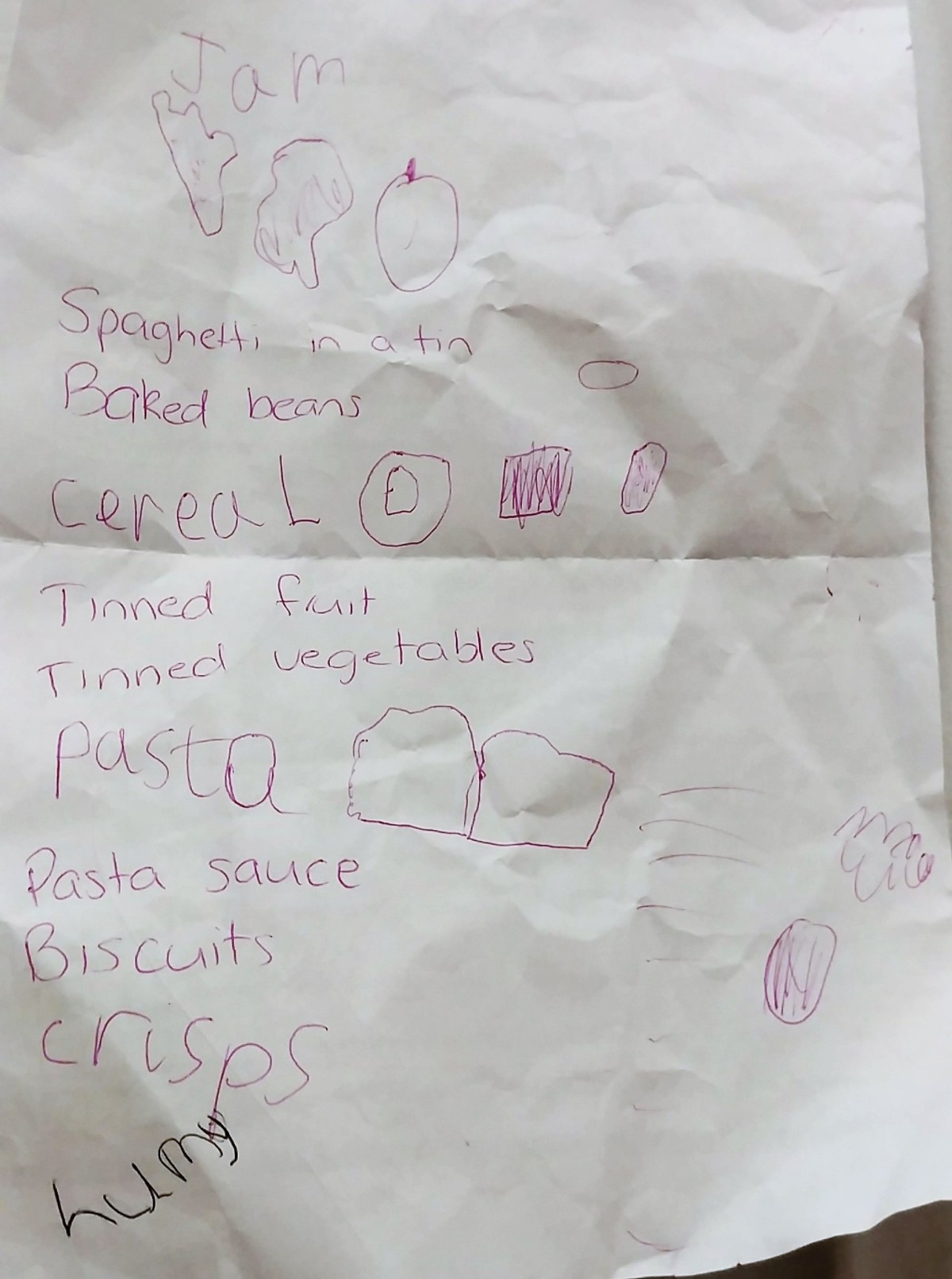
When we got home Eli and I wrote a shopping list together. We negotiated that if he wrote some of the words, I would write others. Eli recalled each of the food types we had discussed as good ideas for the donations over the last couple of days. Eli drew different types of specific food types/flavours under broad headings like “jam” and “pasta”.

list

The day rolled around when it was finally time to do the shop, after a week of discussions and development of plans. We got a trolley and went around to each of the sections collecting items off the list. Eli recalled what he had drawn on his list and stuck only to those items. Strawberry, lemon and orange jams, specific types of cereals and pastas.

We had discussed that finding the cheapest options meant that we could buy more for the families that needed it, so we looked at price tags and found the best bargains. Eli problem solved what to do when there were no cheap coco puffs left, finding a similar shape and flavour product to match his drawing on the list.

We filled the bottom of the trolley with jars and tins and the top was filled with boxes. As we went to get the pasta Eli asked if the shell pasta was for us at home and I told Eli that we would do a shop for us once we had finished this task, showing him my other shopping list for the house. “Oh yes, this trolley is just for being kind, we are coming back in after”. This showed that Eli was understanding what we were achieving. I asked him to take a photo with the trolley looking “kind” and this was his interpretation, which seemed apt as he was being a hero to some less fortunate families.

Screenshot_2017-08-11-20-25-43_resized

He enthusiastically helped place all the items on the conveyor belt and stack them back into our trolley then into the food bank trolley which had recently been cleared out so there was very little in it. When we had finished Eli announced “look, it is more than half full now, that’s all our food for the families”. Eli appeared proud of our efforts to help out other families.

By being involved in the process from the beginning to the end Eli seems to have developed an understanding of kindness and thoughtfulness for others, connecting him as a global citizen and advocate for others. Eli also had the opportunity to share his ideas and engaging with the different steps of the process to complete the task.


What would happen if….? 

I am in England for all of August helping out with my cousin’s children as it is summer holidays over here. The eldest is 6 and loves science. So far we have done lots of things and it has only been a week! 

We made an explosion with bicarb and vinegar. We tried lots of different containers and he lead the way once he worked out what was happening. Problem solving which should go where. Vinegar then bicarb? Bicarb then vinegar? Does the speed which the vinegar is poured make a difference? Does the diameter of the mouth of the container make a difference? All things we problem solved, hypothesised then researched. 

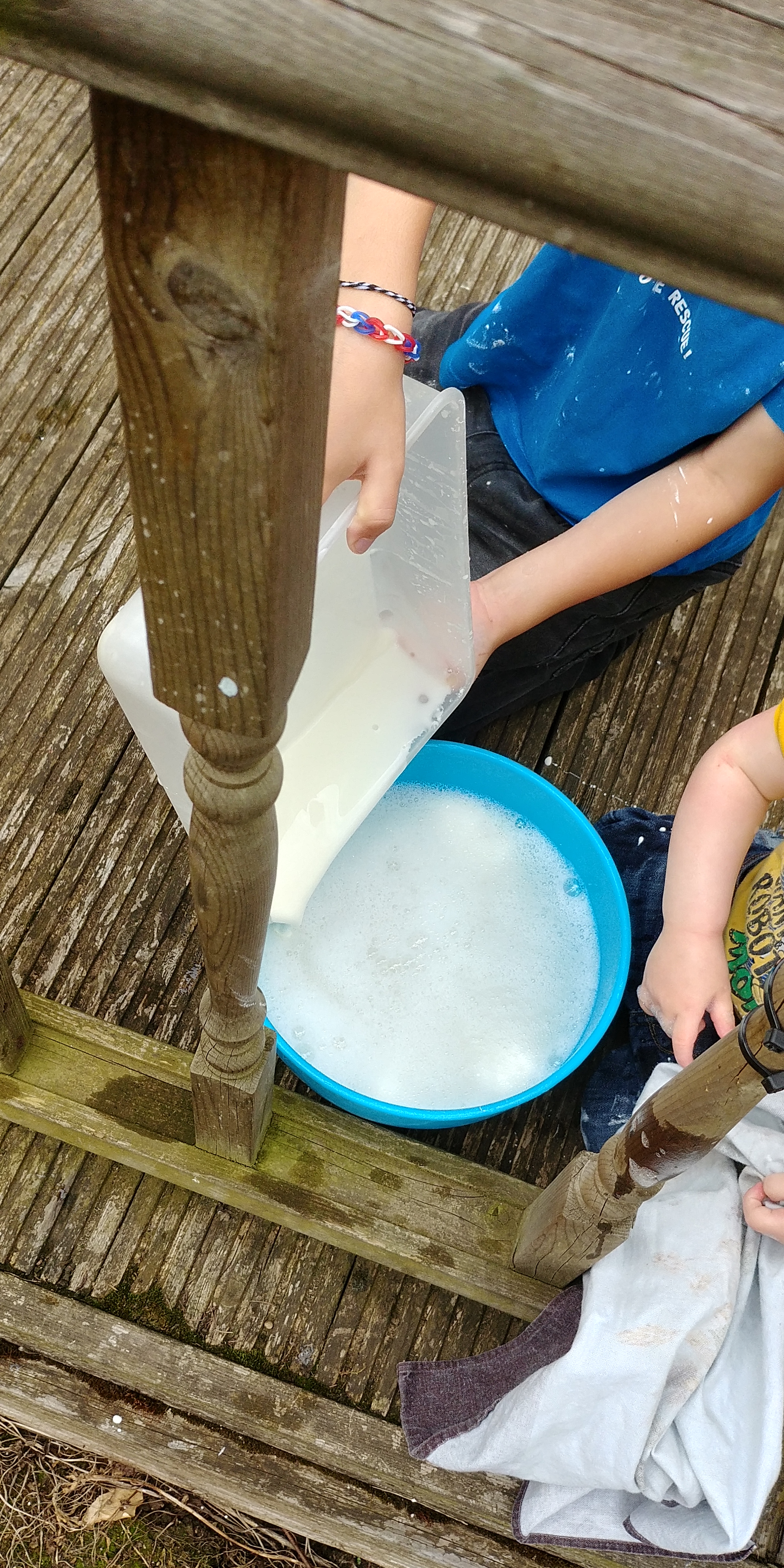
Another experiment involved making goop, seeing what happened when cornflour and water were combined. This then lead on to seeing what would happen if this mixture was poured into the bucket for washing hands. As it was outside and all safe I thought ‘why not?’.  After all, how many great discoveries in history have started with the question “I wonder what would happen if…?” 

We tried another experiment with Skittles that is meant to make a rainbow layered in a jar. We were very patient, mixing the Skittles with hot water to melt them. We developed our fine motor control and perseverance slowly syringing the liquid into the jar so as not to disturb the layer below. Sadly this was not successful, but again he asked the question “what would happen if…” this time transferring his knowledge of jelly, and wondering if the mixture would set in the fridge. We tried, it didn’t, but it was a great hypothesis. 

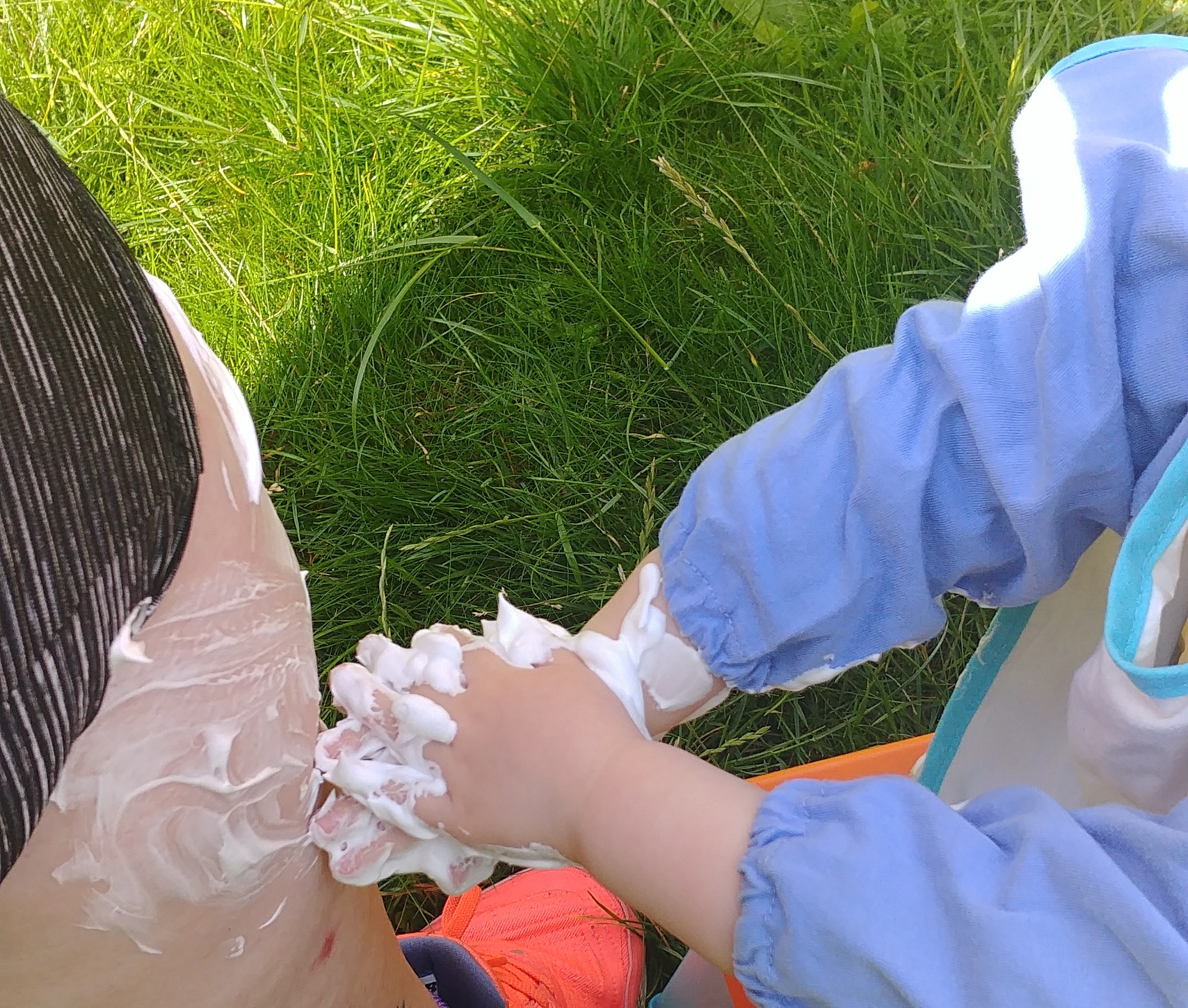
Another experiment involved exploring the properties of shaving foam. This was one that the youngest was interested in. She’s nearly 2. While cautious at first she soon was grabbing handfuls and apparently the best place for them was on my legs. Was she transferring what she had seen before? Was she just wanting to explore the sensation and my legs were an easy reach? Once one leg was done the other was asked for, “nother leg”, then “arm” as she coated me in the foam. We were outside, my legs were uncovered and it is just soap, so I allowed her to investigate and explore, letting her lead the play rather than trying to control it. Normally not one to like messy hands she happily played like this for around 15 minutes. She was also developing sensory awareness, fine motor skills, manipulation, understanding of the properties, communication, and demonstrating a close relationship with me, who she has only known for a week. 

All of these experiments were fun, child focused, playful and educational. By being fully present and following the children’s cues/ideas I was able to learn more about their thought processes and interests. I could have stopped any of these from happening as they did, saying “that’s not what we are doing”, or “don’t do it that way” or “no, it needs gelatin to set”. Had I have done that would the children have the same level of understanding or achieved as many outcomes? Sometimes it’s ok to ask “what would happen if…” and just go with it. Trust that the children are capable and confident and let them have control. 
… 

Sign up for the monthly newsletter at http://eepurl.com/b7KQHT sent on the 1st of each month.

Leadership: Tips on communicating information

Throughout our days we share a lot of information with members of our teams, but do we always pay attention to the way in which this information is shared and the impact that this can have on the employees receiving the information? I have put together some tips that may avoid misinterpretation of information being shared and also allow for greater understanding of the information. These tips also allow educators to connect with the information and engage with the process because they feel it is being done with them, not to them, which can go a long way when working with large teams comprising of varying skills and abilities.

  • Provide the rationale: While we may know the thought process behind what we are asking others to do, it may not always be apparent to them. The more information employees have about why they are being asked to modify practice, or adapt new techniques, or reflect on current practice, the more they are likely to connect with the request. It may take a little longer to explain the information, but it can avoid issues in the long run. Empathy goes a long way. Being able to put yourself in someone else’s shoes and see how the request appears to someone without your experience, knowledge and thought processes behind it can lead to a realisation that the information could come across as confusing, frustrating or even rude. Imagine the following interaction… “I need you to move the block corner to a different area of the room.” “Ok, can I ask why?” “Because I said so” “But the children really enjoy the space they have to play there” “Don’t argue with me, just do it”. How would that feel as the person receiving that instruction? Then imagine the difference being told this… “I’ve noticed that the children are spreading the blocks out into the doorway and this is potential hazard, especially as it is one of our emergency exits. Can you have a think about where a better place for block corner would be to minimise this risk and still let the children play with the blocks in creative and meaningful ways?”.

EM.PA.THY - http://themindsjournal.com/em-pa-thy/:

  • Align the information with the philosophy/vision: We all have a service philosophy, it is a compliance requirement, but if the philosophy is just something that sits on a wall and isn’t referred to, discussed and shared, does it really guide practice? When making decisions for the service these should align with the philosophy and/or vision of the service. If you state that “we have a play based, open ended program where educators support children’s development through role modelling and playing alongside the children” then this can be used when discussing appropriate interactions with children. The philosophy should also be considered when making decisions for the future. If a request has been made to purchase a large play structure for the outdoor environment “because the children are bored and just run around” then the philosophy can be used to assess whether the purchase would align with the example statement used above. Are the educators aware of their impact on the children’s ‘boredom’? Do they think the large structure would provide open ended learning? Are there alternatives to alleviate the issues in the outside playground that better align with the philosophy?

“A leader's job is to look into the future and see the organization, not as it is, but as it should be.” - Jack Welch #leadership #business #quote http://www.insperity.com/blog/?insperity_topic=leadership-and-management&keywords=&paged=1?utm_source=pinterest&utm_medium=post&utm_campaign=outreach&PID=SocialMedia:

  • Be mindful of how you present information: Often information is shared as we see things, which may have annoyed or frustrated us, so they can be shared in short, sharp ways. The information may be shared at staff meetings, when everyone is generally tired and drained from a full day at work, so information may be shared in a matter of fact way, read off an agenda and discussed without much enthusiasm or energy. Or the information can be shared via text based mediums such as emails or signs, which allows for interpretation from the reader based on assumptions and their current mood. When it comes to interpreting information, the way in which information is shared is often more important than what is being said. If the person receiving the information feels it is negative, based on the body language and tone of voice used, they may feel like it is going to be difficult to implement or impact their current role negatively and therefore push against the changes. On the other hand, if information is shared in a way that makes it sound like a positive challenge that will develop skills, knowledge and the overall outcomes of the service, then employees are more likely to engage with the information and connect with the requests. Positive facial expressions, cheery tone of voice and open body language (avoid looking down, crossing arms, hands in pockets, fidgeting, etc.) can impact the message being received, so it is important to be mindful of how we feel and present ourselves when sharing information.

people may not tell you how they feel about you but they always show you:

  • Provide support and guidance: If we expect educators to work on their documentation to get it up to scratch, because it is lacking, do we provide examples of what we are looking for and time for them to achieve this in? If we ask the educators to move the room around to reposition block corner do we give them a time frame on when this can be achieved? If we expect room leaders to add articles in the newsletter each month do we go into the room and replace them on the floor so they have time to achieve this? If educators do not have the tools and resources required to complete the tasks they are being asked to do they may feel frustrated or overwhelmed and this can cause issues in the workplace such as disengagement, attention seeking or other negative behaviours. By supporting educators to complete tasks they have been given, whether it be through role modelling, mentoring, training or rostering additional time, this can help employees feel valued and empower them to achieve positive results.

Absolute truth!:


Sign up for the monthly newsletter at http://eepurl.com/b7KQHT sent on the 1st of each month.

Identifying Strengths for the QIP


When it comes to writing our QIP and updating it, we tend to spend more time on the goals and outcomes than the strengths. Often this is because we are so busy getting through everything that we need to get through that we forget to celebrate the positives and what makes us great. Here are some tips for building your strengths section of the QIP:

  • Focus on what makes you stand out, not compliance: The regulatory authorities expect that you will be compliant in the requirements of the NQF, they want to know what makes your service unique and why people choose you over another service, or how you utilise critical reflection to develop and grow as a service and remain viable and reflective of the community.
  • Get help from your stakeholders: Use surveys, discussions and feedback to help form your strengths. Often we get so focused on the day to day we don’t have time to step back and see what makes us different, or visit other services to see what we are doing that is great and innovative. Our employees and parents have access to other services, through previous employment or visits to services, and therefore can help us see what made them choose us.
  • Turn weaknesses into strengths: The way in which you address a potential weakness and focus energy and resources into it can turn it into a strength. These are the types of things that show regulatory authorities the way your service overcomes adversity and reflects on situations to change and adapt.
  • Paint a picture of what is important to your service: The whole point of the QIP is that it is the first overview of your service the regulatory authority receives, and therefore is starting to share with the officer what is meaningful to your service. Using strengths to focus on what is of value to your service, and what you feel about your service, helps officers to understand the journey you are on.
  • Don’t forget to update your strengths: When you go through the QIP every year and update it, add in any relevant strengths that have developed over that time. This may be because goals have been achieved, it may be because grant money was provided, it could be because an innovative new project was implemented, or it could be as simple as the stability of the service is allowing for more professional growth and development. Strengths may not develop every year, but when there has been improvement it should be noted.

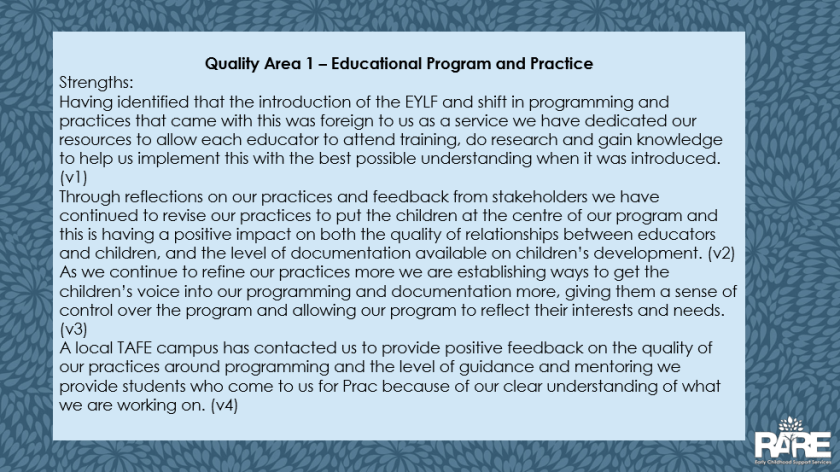
Below are two images that demonstrate some of what was mentioned above, and the version update is recorded to show progress and development over time.

strength1

strength2

Sign up for the monthly newsletter at http://eepurl.com/b7KQHT sent on the 1st of each month

Rethinking compliance evidence

Many of the educators that I talk to, or the services that I visit, worry that they are always adding to their workload and having to do documentation that meets the needs of the families, and more documentation that meets the needs of the NQF and more documentation that suits the communication style of their educators.

With all the technology that exists today and the way that it is utilised to share information, communicate with others and create instant connections, we often find ourselves using this technology in our services. It is worth considering how you use technology and social media in your service to meet compliance and also support evidence of this. This can prevent you from doubling up on work or allow you to reframe what you currently do in line with the requirements.

An example of this is the use of multiple apps, programs and software types available to share updates on what children have been doing that day within the service. This has developed over time as a means of building relationships with families and allowing them to feel connected with their children when they are at work or occupied elsewhere. Lots of these examples also meet the criteria of the regulations in that they share with families information about their child’s engagement in the program. If you are doing this already, do you also need to do a daily diary? Is this duplication and yet another thing that takes educators away from the children? Consider how what you are currently doing meets the requirements, how you share with families that they can access the digital information, and what you do if there is a family who does not have access to the digital version.

Another example is the use of closed Facebook pages, group chats and email chains between staff that tick the boxes for reflective thinking, collaborative work, sharing knowledge and skills, affirming and supporting each other, and communicating in a way that is respectful and professional. If you are already doing these things and it is working well for your team, acknowledge this and identify these types of communication as evidence for so many different areas of the NQF.

It is not always about doing more, it is often just about reflecting, reframing and realising what you are already doing in your own way and how this already meets the requirements. The added benefit of these examples is that you have tangible evidence to produce through screen shots and emails that you can print out and provide for assessment and ratings.


Sign up for the monthly newsletter at http://eepurl.com/b7KQHT sent on the 1st of each month

Teamwork

teamwork-mixed-up

Does your team look a bit like this? Is everyone working independently and going in different directions and you don’t know how to get them back together? Sometimes it can seem like it is impossible, and we are fighting an uphill battle because we have so much to do, and so little time. Not only are we busy, but the educators are also busy so how to we find time to sit and connect with them and ensure everyone is on the same page when they are all working on their daily tasks too?

Obviously every team is different and there is not going to be one magical solution (sorry!) but there are some simple steps that can be taken, and some quick and easy procedures that can be implemented to help get your team on the same path and looking a bit more like this…

teamwork-nearly-done

Explaining why: Often if people know why they have to do things a certain way, or change their practices, or collaborate with others it becomes easier to process and accept. Sometimes the reason why is “because it is a requirement” but this should not be the only reason. Does it benefit the children? The service? The community? The educators? Reflect best current practice? Allow for consistency? and so forth.

Having clear policies and procedures: Making sure everyone is aware of the requirements and has documented evidence to refer back too. It is important to make sure the policies are up to date, so they match required procedures, and also that new policies are created to fill gaps if a situation arises.

Communicating service goals: By utilising the QIP to explain what goals the service is currently working towards and even how educators can help with these, can support the service to be working towards common goals. This also allows educators to feel a part of the process and connected with their service. You could use something like this…

qip-comm

Reflective practice: By encouraging educators to question the norm, be creative, collaborate together and ask “why?” or “why not?” it supports educators to connect more with the service. Sometimes the reason educators don’t appear part of the team is because they don’t feel part of the team. This leads to them showing up, doing their job, and going home. But if everyone is communicating and asking questions and trying new things and there is a safe and secure culture to do this in, then this can help engagement.

Establishing educator goals: Each educator should be working on a goal at all times, this keeps them engaged, focused and supported. Goals can be anything from working on arriving at the service on time for shifts, to investigating transition activities to help support the flow of the routine, to establishing a connection with the local school and working out a roster of excursions. For more information click here

Role modelling: Often it is hard to be an off the floor director/nominated supervisor/manager and have so many jobs to do that getting into the rooms can be difficult. Depending on what is happening in your service, try and take some time to be in the rooms and role model appropriate skills. Whether it be setting up inviting spaces, being creative with use of resources, following the children’s lead, following procedures, or even just reflective practices, if you lead by example, instead of giving directions, sometimes this can help educators see what the expectations are.

Having a code of conduct: The regulations require services to have a code of conduct, and many use the ECA code of ethics for this. A code of conduct states what one party is required to do/how they will behave, and then what the other party will do in return. This can often be useful for specific situations like a staff meeting, but it can also work to unite a team. It states what educators will bring to the table, and in return what management will provide. Everyone collaborates on the document, so it reflects everyone’s voice, and then sign it to agree to the code. It is a handy document to refer back to if educators are not pulling their weight, or if there is a question as to why some members of the team get more benefits than others.


Sign up for the monthly newsletter at http://eepurl.com/b7KQHT sent on the 1st of each month


Surviving the heat

If you are in a part of the country that has experienced the exceptionally hot weather this summer here are some tips to support children during the hot weather…

  • Make sure you follow sun smart policies. Wear appropriate hats, clothing and sunscreen, and avoid going outside in the hottest part of the day, and monitor the UV levels.  
  • Monitor the temperature of floors and equipment. Even though the weather might cool down metal, rubber and plastic items can hold their heat for extended periods. If things are still too hot to touch manage this my avoiding areas, wearing shoes and so forth.
  • Minimise running around for the children. Children often don’t notice the heat but they can make themselves ill  with heatstroke and dehydration from running around in the heat. You can do this by providing lots of quiet and inviting areas including table activities, mat activities and so forth. 
  • Utilise water and ice. Water can be used in many different ways from water troughs to painting with water, watering gardens, washing toys, sprinklers and so forth. Ice makes a great addition to cool children down but also introduce science with melting, floating, etc.  Paints can be frozen to add an additional creative method to paint. Toys can  also be frozen into ice so children can work on freeing them. There’s some suggestions I’ve saved to my pinterest board if you would like to check it out http://pin.it/Twxzzgw 
  • If staying inside support physical activity. Ensure there are still physical opportunities, whether it be dancing, games or bringing in some safe outdoor resources. Setting up a tunnel, ball pit, low obstacle course etc can all help children develop gross motor skills while inside. 
  • Encourage lots of fluids. Ensure children drink a lot of water to stay hydrated. You can also have some healthy frozen treats like frozen fruit (watermelon works great), home made ice blocks with fruit infused into water or very diluted juice.  

Hopefully everyone finds ways to stay safe and cool. If you have any great tips for staying cool in child care please comment below. 
If you would like to subscribe to my monthly newsletter for tips, ideas and upcoming events subscribe here http://eepurl.com/b7KQHT