Explaining School Readiness to Families

Tonight I did a webinar on Language and Literacy without structured activities like stencils, flash cards, board games, large group activities like news, repetitive songs like the alphabet song and ants in the apple. I was asked how you demonstrate school readiness to parents who want their children to read and write before they start school if you are using this play based, child focused method.

Here are some tips:

  1. You are the professional. Parents choose to enrol their children in your service for your skills and knowledge on child development. Use your knowledge and research to explain to the families what school readiness is really all about, and what is developmentally appropriate.
  2. Do your research. Understand what is developmentally appropriate, what the schools are looking for and how to meet this. Talk to your local schools and find out what they are looking for. Then share this with the families to lower their expectations to help support the children’s transition. Here are just a few of the many links from different sites on what school readiness looks like in Australia (note it is realistic and in line with child development/EYLF):
  3. Check your policies. Make sure your policies are reflective of current research, and use these to explain how you meet the requirements. For example- state that “children have opportunities to develop their literacy and numeracy skills through every activity as our talented and qualified educators provide resources and intentional teaching that support acquisition of skills. Through engaging in meaningful and varied experienced children develop not only skills that will assist with the transition to school, but more importantly, they develop dispositions for learning such as enquiry, agency, resilience, problem solving and creativity.”
  4. Demonstrate your work. Create displays, documentation, newsletters, programs etc to demonstrate to families how you are preparing children for school. Keep it in line with your research and policies, but make it apparent to families that you value and embed school readiness in multiple aspects of your program in an ongoing basis.

Image result for school

School is intense, it is busy, there is a lot to do, but children who are overwhelmed, frustrated and anxious because of their experience in the years before school will not do well. Neither will children who have been pushed to learn things that have been taught incorrectly and the school needs to “un-teach” and start again.

As you can see from the links above nothing is that intensive, so feel confident enough to share this, respectfully and professionally, with the families to help build those partnerships. Put the information in enrolment packs, newsletters, facebook posts etc etc. Get the school in to talk to the families. Anything that will take the pressure off the children and free them up to learn and develop, instead of missing out on their childhoods. They have 13 years of structure and stencils to come.

If you would like to subscribe to my monthly newsletter for tips, ideas and upcoming events subscribe here http://eepurl.com/b7KQHT


Thinking outside the square

When was the last time you did something different in your program? Not just brought something different out of the storeroom, but tried something different. There are SO many different ways to teach concepts and skills. You don’t need to use structured activities to teach letters and numbers. You don’t need to drill children with flash cards and repetitive daily activities to teach them skills and concepts.

Take colour mixing for example. Usually we do this with paints. “What will happen if we mix blue paint with yellow paint? Oh look, we made green!” How many others ways can you think of to mix colours while exploring other skills at the same time?

If you squish yellow playdough and blue playdough together you get green. You also get strengthened fine motor strength, control over the shade of green, hypothesising, experimenting, research, problem solving, creativity when they then use the dough for other things.

Another way to colour mix is through the science experiment where you add food colouring to milk and then add a drop of detergent. As the milk swirls around with the detergent forcing it around, then the blue and yellow will meet and mix. It may need the additional help of another drop of detergent.

And then gradually you start to see green appear as the colours join and mix.

Not only do you learn about colour mixing but you also get to learn about science, explore what might happen, problem solve how to move the colours around more, hypothesise why it is moving, use language skills to express what is happening etc.

Hopefully this will encourage you to think about different ways to bring learning into your program. These are just 2 ways to incidentally explore colour mixing while doing other activities. I’d love to hear how you exploring colour mixing within other activities. Please let me know in the comments below.

If you would like to subscribe to my monthly newsletter for tips, ideas and upcoming events subscribe here http://eepurl.com/b7KQHT. Newsletters come out 1st of the month.


Group Time: A Critical Reflection

The purpose of this post is to provide an opportunity for reflection on what currently occurs in your service and the pros and cons of group time.The purpose of this post is not to say what should or should not be occurring in your service around group time.  Hopefully this post will allow for critical reflection and a deeper understanding of why you do what you do in your service.

Now when I say group time I am talking about a structured large group activity, usually with 8 or more children in it, that has been planned and/or is a predetermined time in the routine. Here’s the requirements around group time…

  • Regulation 156   Relationships in groups 

    (1)  The approved provider of an education and care service must take reasonable steps to ensure that the service provides children being educated and cared for by the service with opportunities to interact and develop respectful and positive relationships with each other and with staff members of, and volunteers at, the service.

    (2)  For the purposes of subregulation (1), the approved provider must have regard to the size and the composition of the groups in which children are being educated and cared for by the service.

  • NQS – Element 1.2.3: Critical reflection on children’s learning and development, both as individuals and in groups, is regularly used to implement the program.


These are the only time group is mentioned in relation to the program and relationships with children. However the following requirements are important to mention when reflecting in group time…

  • NQS – Element 1.1.1: Curriculum decision making contributes to each child’s learning and development outcomes in relation to their identity, connection with community, wellbeing, confidence as learners and effectiveness as communicators.
  • NQS – Element 1.1.2: Each child’s current knowledge, ideas, culture, abilities and interests are the foundation of the program.
  • NQS – Element 1.1.3: The program, including routines, is organised in ways that maximise opportunities for each child’s learning.
  • NQS – Element 1.1.5: Every child is supported to participate in the program.
  • NQS – Element 1.1.6: Each child’s agency is promoted, enabling them to make choices and decisions and to influence events and their world.
  • NQS – Element 1.2.1: Each child’s learning and development is assessed as part of an ongoing cycle of planning, documenting and evaluation.
  • NQS – Element 1.2.2: Educators respond to children’s ideas and play and use intentional teaching to scaffold and extend each child’s learning.

So knowing all of this information here are some reflective questions for you:

  • Why do you do group time?
  • Does each child have an opportunity to engage with the learning that occurs in a large group?
  • Are the educators able to identify and assess each child’s learning in a large group?
  • How does group time help children prepare for the transition to school?
  • How do you manage the children who are interested and engaged, and those who are disinterested or disengaged?
  • Do the children have a voice in what is discussed at group time? Do they have the ability to make decisions?
  • How do children with additional needs or different ages participate in the group time?
  • How much time is spent with educators “managing” the children during the group time, vs engaging and teaching?
  • Do educators enjoy doing group time?

Knowing the requirements and having honest critical reflection can help either re-ignite the reason why your routine and program happens the way it does, with group time as an integral part, or provide an opportunity to explore other avenues if you no longer feel group time serves a purpose.

If you would like some training or consultation around this please feel free to get in touch. Otherwise if you would like to subscribe to my monthly newsletter for tips, ideas and upcoming events subscribe here http://eepurl.com/b7KQHT

The benefits of planned transitions

Often transitions between one part of the routine and the next are chaotic, confusing, stressful and not at all child focused. They revolve around the needs of the educators and whether they have finished what was just happened and if they are prepared for what is about to happen. Some common transitions can be between inside and outside play, before meals, before or after a group time, before toileting/hand washing.

Children are not designed to wait. They are not designed to queue in a line waiting for the bathroom for long periods. They are not designed to sit unsupervised on the mat while they wait for further instructions as the room is packed up. It is often a cause of stress, anxiety, and even behavioural issues in children. Children with separation anxiety often have time to pause and think about how much they miss their family when there are not planned transitions, and therefore periods of waiting, causing them to become upset again.

Through planned transitions you can have the following benefits:

  • Getting additional learning into your program.
  • Assessing children’s skills in a range of areas.
  • Children are busy and engaged so less behavioural issues/anxiety.
  • Children are sent in small groups to the next activity to avoid chaos or queues.
  • Transfer skills/knowledge into a different context.


Some suggestions of transition activities are:

  • Singing songs like 5 cheeky monkeys, 3 jelly fish, 5 speckled frogs, 5 grey elephants etc and having the children act out the role and when they are eaten, or fall/jump off, they are sent to the next activity. 5 elephants
  • Have the children recognise shapes/patterns etc and seeing whether they pay attention, and sending children based on what they are wearing. You can pick basic things like colours of clothes, or patterns/pictures like stripes, stars, trucks, letters, numbers etc, or even increase vocabulary by the type of shoes etc. Just make sure if you are sending onto something with a number limit (like the bathroom) you pick something that isn’t very common and will only see 3 or 4 children go at a time.
  • Have the children recognise their names in more challenging ways as they become more capable. Start with just saying their name. Then people who’s name start with a letter, or rhymes with something (“wibbly wobbly wessica, an elephant sat on Jessica”), then move on to spelling names. It is surprising to see how many children know how to spell other people’s names.
  • Have children pay attention, remember and recall information through activities like 5 currant buns, but switch it up to 5 sandwiches or 5 ice-creams as examples. The children who are the items get to pick what flavour they are, and the children who come up to pick one have to remember what flavour the child is that they pick. To be inclusive you can allow the children who are still developing skills in this area be the ice-cream etc and they just need to think of a flavour, not remember who was what.
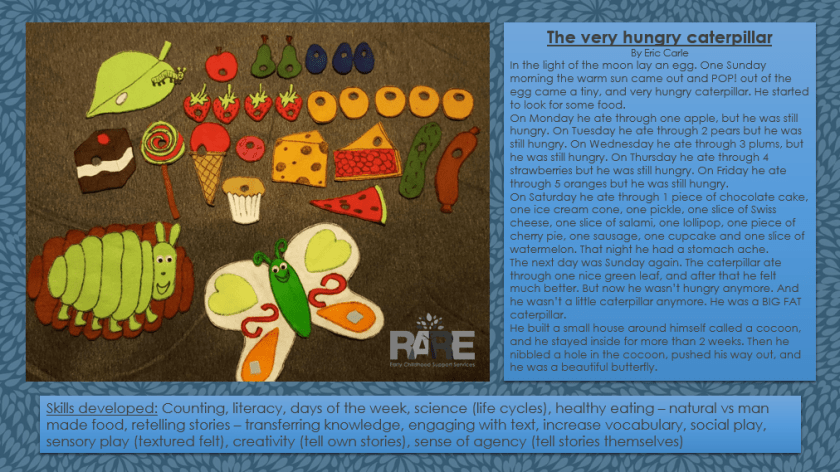
  • Use felt board stories or similar for children to come and add a piece to the board as the story is told. A good transition for children who are moving to another activity in the room, such as lunch, so they can still hear the story. Hungry Caterpillar

If you would like to subscribe to my monthly newsletter for tips, ideas and upcoming events subscribe here http://eepurl.com/b7KQHT


5 tips for Managing your time

There are so many things to do during the day from observations to daily check lists to meals, routine times and writing the daily diary for families. Often it can feel like we are always struggling for time and herding the children around so we can get our jobs done. Here are 5 tips to help you manage your time…

1

Reflect on why you are doing each task – Look into why we do the many tasks we do in a day, who we are doing them for, whether they serve a purpose, or whether we feel we should be doing them. If families don’t read the daily diary and just look at pictures, why write an essay in it? Are all of the WHS checklists necessary or could they be combined or cut back?

2

Explore the times of day things are done – When are these tasks being done? Do they interfere with relationships with the children? Do they cause added stress? Do they require all the children to be in a teacher directed activity for an unreasonable amount of time while these tasks are done? Instead of writing the daily diary at rest time when children are not resting, why not write it at lunch time when they are all sitting and busily eating and 1 educator can be documenting while supervising and keeping an eye out.

3

Consider when children are most engaged – If we want children to be busily engaged when we write documentation, so we don’t need to be worrying about what they are up to, then perhaps we need to reflect on what this means. Are children most engaged when having an educator run a large group for long time periods of time when children have the opportunity to get bored or cannot developmentally sit for long periods of time? Or are children most engaged when they have challenging, open ended activities based around their interests to play freely with? Which one is likely to allow for more freedom complete tasks?

4

Multi-task – When doing documentation or other tasks around children do not be so absorbed in what you are doing you are ignoring the children. Sit near a group of children, get up and move when they move. Think about if the parents were watching, would you like them to see an educator sitting and writing documentation in a quiet corner of the room and ignoring the children? Or worse, saying to children “not now, I have to write this, go play.”

5

Get the children to help – Have a paper daily diary and get the children to help write in it, draw in it, talk about what to write, become involved and even plan for what to do the next day. This will help children to be engaged, be included, and also provide them with a voice and sense of agency over the program as they develop literacy and language skills in a meaningful way.


If you would like to subscribe to my monthly newsletter for tips, ideas and upcoming events subscribe here http://eepurl.com/b7KQHT

5 tips to support a child focused program

Children are often the reason we get into child care. We want to make a difference in a child’s life. The best way to make a difference to children is to put them at the centre of everything you do. Remember why you got into child care and don’t let all the other tasks bog you down. Here are 5 tips that can help you develop a child focused program…

1

Build relationships – Get the know the children, spend time with them down at their level and see what makes them tick. By getting to know the children you will start to see what they need help with, what their interests are, and where they would like to take the program. Children who are interested in what they are learning about are more likely to get more out of the experience.

2

Don’t be selfish – Put the children and their needs first. It isn’t about you and making your day easier by being in control, it is about the children and making their day easier by supporting their needs. I guarantee if you relinquish the need to be in charge and control everything and just engage, play, scaffold and be you will have a much more relaxed day because the children wont be resisting, or disengaging because they are not developmentally ready, they will be right there with you learning through play.

3

Be flexible – Try something new, if the children cannot engage with the program the way it is, then mix it up. There is nothing stopping you from experimenting with the program delivery to find ways that best meets the needs of the children. If children are engaged in the program, feel like they have a voice, feel like they can exercise their sense of agency then they will be busy, challenged and supported. You might find less behavioural issues when children are not frustrated, bored or disengaged. So try something new, mix it up, be adventurous and most of all, be brave enough to try.

4

Build a catalogue of ideas – Things like professional development, industry publications, networking, even Pinterest can be great for learning new ways to use resources, new ideas for setting up the environment, and new activities. The aim of all of this is not to come back into the service the next day and try them all, because that is about you, not the children. The aim of all of this is to build a catalogue in your mind of ideas you have on hand that when the children are interested in something, or engage in something, you can pull an idea from the catalogue in your mind and challenge the children further.

5

Understand the benefits – Reflect on the NQS and understand how a child focused program can support not only the children but also support the service to meet the elements in many of the quality areas. Child focused programming is also a very inclusive practice because it means that children with additional needs can play a key role in shaping the program, instead of being dragged along with the program, or left out of it.

Hopefully this has been helpful to you and given you some things to reflect on in your service. Perhaps it is that you are already doing all of these, perhaps it is how you could do better, or maybe it has affirmed some of the things you do but given you food for thought on others.

Remember, there is no ONE way to implement the NQF so if what you are doing isn’t working, give yourself permission to try something new. If you would like help with anything in your service please feel free to get in touch or check out some materials available at http://www.rare.support

If you would like to subscribe to my monthly newsletter for tips, ideas and upcoming events subscribe here http://eepurl.com/b7KQHT


5 tips for making your day more enjoyable

We all want to decrease stress and increase enjoyment when it comes to work. When working with children there is always going to be curve balls thrown your way, things we can’t predict, however most days can be not only manageable, but actually enjoyable. Here’s 5 tips to help you enjoy your day at work…

1

Spend time with the children – I know this sounds a bit “well derrr” but how many minutes/hours a day do you actually just be with the children? Not running a group time, not transitioning them, not correcting behaviour during supervision, not frantically trying to get an observation of them. Play alongside the children, reconnect with why you got into education and care in the first place. Whenever I was having a stressful day in the office I would come out and just sit and chat with the children and everything was right with the world again.

2

Relinquish control  – Being an educator isn’t about being in  control all the time. Part of the reason we have stress in our day is because we are trying to control groups of children who are all so different and have such different needs and interests that they cannot be expected to meet our strict expectations. Loosen then reigns a bit and provide the children with the rules, set the limits and boundaries, and then trust them to be capable of following these rules with your support and guidance.  

3

Keep children engaged – The more children are interested in something, the more they will engage with it. The more engaged children are, the less likely they are to get bored and start testing limits and boundaries. Get to know the children and provide activities that reflect their interests and are open ended so they will be engaged for longer periods of time because open ended activities don’t have time limits. Through these activities children can learn a vast array of skills if the right resources, role modelling and questions are provided.

4

Reflect on practices –  If you are finding work stressful then maybe you need to reflect on either the service’s practices, or your own practices, to see if there is anything in particular that is causing the stress. It is so much easier to fix an issue once the issue has been identified. For example you might have a really good day but go home stressed every evening so upon reflection you recognise that the lock up procedure is not working when parents are coming and there are so many tasks to do.

5

Know the policies –  For those times when something unexpected does come your way it is important to have a general awareness of policies and procedures so you can confidently and quickly handle the situation and minimise the stress.

Hopefully these tips will help you have more enjoyable days in your service. Don’t forget that if you are really stressed of struggling you need to speak to someone, whether it is a supervisor or a trained professional. This is not a good headspace to be in when working with children, and is likely going to have a flow on effect for other educators. It is important to make sure you look after your own mental health and speak up.

If you would like to subscribe to my monthly newsletter for tips, ideas and upcoming events subscribe here http://eepurl.com/b7KQHT

5 tips to be compliant within the NQF

I think it is fair to say that most of us want to succeed at work, but not only succeed, but challenge ourselves and improve in our practices and knowledge. We want the service to be implementing the best practices and to be meeting compliance in all aspects of the NQF. Here are 5 tips to help you achieve compliance…

1

Know the regulations – I often see people questioning how to protect children and what procedures are in another service, to make sure they are doing the right thing. There are regulations on a range of different areas including space requirements, giving medication, going on excursions  and staffing requirements. There are even regulations on what policies you need to have and what should be included in these. If you would like the provide best practice you need to know the regulations.

2

Know the NQS elements – A lot of us know the Quality Areas and the Standards but how many know the elements? It is important to not only know, but understand each of the elements and how they are met in your service. For example while you might think your educators are respectful and ethical in their interactions (standard 4.2) do they meet element 4.2.3 “Interactions convey mutual respect, equity and recognition of each other’s strengths and skills” and focus on each others’ strengths?  

3

Be aware of other legislation – The National Education and Care Services Regulations are not the only legislation guiding services. How much do you know about the pother legislation like child protection act, work health and safety regulations, fair work regulations, and the privacy act just to name a few. There are also specific codes that impact buildings etc depending on your location. Being aware where to look for answers as and when issues occur will help you meet compliance.

4

Know where to find information on best practice – There are so many sources of information available to help support services in identifying best practice. For example on the ACECQA website any many guides, Staying Healthy in Childcare, publications such as Every Child and Rattler. In addition to this there is also training available to find out what you can do to meet best practice and compliance requirements.

5

Don’t be afraid to ask for help – If you are not sure about something, or need help ensuring compliance then it is ok to ask. There are many different services out there to help you, whether it be because you are going through something totally out of your realm of knowledge, you just don’t have time to read all the documents, or you don’t quite understand what you have read. [NB make sure you are seeking help or support from the right people, for example asking a question on Facebook might not get you the correct information]

Don’t forget to also make sure any areas you are working on go in your QIP so authorities understand where you are up too. Hopefully you find this helpful and if you would like some help with compliance I would be happy to work with you. There is also some documents available at http://www.rare.support/store to help make sure you have complied with different areas.

If you would like to subscribe to my monthly newsletter for tips, ideas and upcoming events subscribe here http://eepurl.com/b7KQHT


5 tips to reflect the EYLF in documentation

We are told to include the EYLF (or other approved frameworks) in our documentation. How you do this is up to you, but there meaningful ways and ticking boxes ways. The following is 5 tips you might like to consider ways to make the EYLF meaningful in your documentation…

1

Understand the Learning Outcomes – The Learning Outcomes are very broad in their application and cover a range of different activities. 1 is not just for new children, 2 is not just for group games, 5 is not just for reading books. By taking the time to really understand the Learning Outcomes you can truly understand how they are reflected in your program.

2

Explain the role of the educator – We often get caught up in the children and the Learning Outcomes, but the EYLF is also about the educator in the Practices. When doing your documentation is it all about the children or is the educator mentioned? Did they ask questions? Did they get more resources? Did they role model different ways to use the materials?

3

Use educational language – Another part of the EYLF is using Pedagogical Documentation. This is about not wasting words by writing a pretty little piece about the children’s fun day, but instead using the language of the EYLF and referring to the learning that occurred. If the service prides itself on the educators’ qualifications and skills, then highlight the learning in the documentation.

4

Understand the service’s interpretation of the Principles – The final element of the EYLF is the Principles. This is like a philosophy for the service to explain how they interpret 5 key aspects. This should be discussed as a service and guide how the Practices (role of the educator) supports the Learning Outcomes (children’s development).

5

Give the child a voice – Don’t assume the child’s thoughts and emotions. Use their words and actions to give the child a voice in the documentation. For example instead of saying “Jack was frustrated with his tower falling down” you can say “Jack appeared frustrated with the tower falling down as he sighed and growled”.


If you would like additional support with understanding the EYLF there are glossaries for the Learning Outcomes, Practices and Principles, as well as a pedagogical documentation cheat sheet with some key words to use to emphasise the learning available in the online store. There are also previous webinars on EYLF related topics and the embedding the EYLF program. For more information visit http://www.rare.support or contact for personalised support/training 

training inhouse

If you would like to subscribe to my monthly newsletter for tips, ideas and upcoming events subscribe here http://eepurl.com/b7KQHT

Everything has learning potential 

I went to have a meeting with some educators about their program and we were discussing ways to get the children’s voices into outside school hours care documentation. I mentioned having the children document what they would like to do, what they would like to eat etc. I was told they often say they would like McDonalds for food. I suggested this could become a project. 

If it is something the children have mentioned several times then they could start to do some research to see if this is a viable option. How far away is McDonalds? How could they get there? What would everyone order? How much would this cost? How would they get the money? Would they fundraise? Would one person go and get everyone’s orders? Would it be hot when it got back? They could then come to their own realisation that it wouldn’t work.  

This could take weeks to explore s a project, and evolve into more opportunities. If the children couldn’t get McDonalds then maybe they could plan to make their own burgers. Look up recipes, work out how much of each ingredient they would need for the number of children etc.  

It is all about looking at the learning opportunities in everything and documenting it accordingly. Don’t dismiss something the children are talking about because it isn’t what you had planned, challenge yourself to look at the learning opportunities in that interest. You could talk about maths (distances, quantities and money), planning, research, literacy (writing lists and reading recipes), collaboration and so much more when documenting this to highlight the learning occurring to the reader, reflect and plan ahead further.